

Hosted Payment Page vs API Integration: How to Choose for Latin America
Hosted Payment Page or API? Compare speed, control, PCI scope and local payment flows to choose the right integration for Latin America.
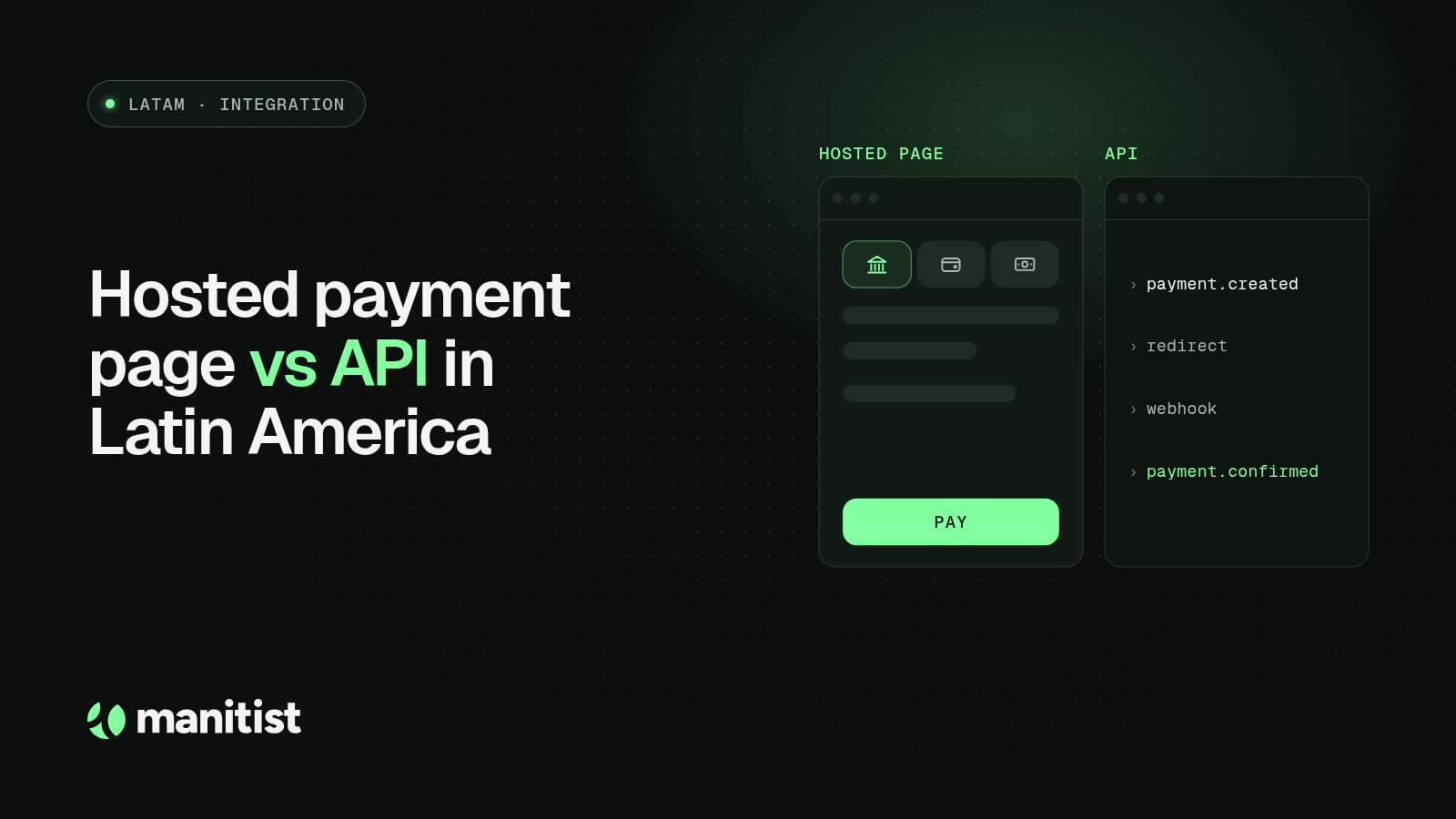
When you add local payments in Latin America, one of the first decisions is how to integrate: send customers to a hosted payment page, or build your own checkout on top of an API. Both work. The right choice depends on how fast you need to launch, how much control you want over the experience, who builds it, and how you handle card data. This guide compares the two and offers a simple way to decide.
What is a hosted payment page?
A hosted payment page (HPP) is a checkout page run by your payment provider. You create the payment, send the customer to the hosted page or embed it, and the provider displays the payment methods, collects the customer's details, handles the steps specific to each method and returns the result to you.
In Latin America, that last part carries real weight. Local methods don't behave like cards:
- A bank redirect (such as PSE in Colombia) sends the customer to their bank to authorize.
- A QR payment needs a code, a countdown and a clear instruction to scan it from a bank or wallet app.
- A cash voucher (such as OXXO in Mexico or Efecty in Colombia) needs a reference, an expiry and a clear explanation of where to pay.
- A bank transfer (such as SPEI) needs the right account reference and amount.
A hosted page presents all of these in the customer's language and local format without you building each screen.
What is an API integration?
With an API integration, you build the checkout yourself and use the provider's API to create payments, retrieve their status and receive updates. Your design, your front end, your rules. You also own the details: how each method is displayed, how pending states are explained and how errors are handled.
A well-designed payments API typically exposes predictable objects for deposits, withdrawals, refunds and webhooks, so the same patterns apply across markets.
How they compare
| Question | Hosted payment page | API integration |
|---|---|---|
| Time to launch | Usually faster | Longer, depends on your build |
| Control over design | Limited to what the page allows | Full |
| Engineering effort | Low | Higher |
| Local method screens (QR, vouchers, redirects) | Provided | You build and maintain them |
| Card data handling | Stays off your servers | Depends on your design |
| Best for | Fast launch, small teams, new markets | Custom UX, apps, high-volume tuning |
PCI scope: what actually changes
If you accept cards, the PCI Security Standards Council's guidance matters for this decision. Its published FAQ explains that a merchant whose payment page elements all come from a PCI DSS-compliant service provider may qualify for the shortest self-assessment questionnaire, SAQ A, provided other SAQ A criteria are met. A redirect to a provider-hosted page is the cleanest case. An embedded provider iframe can also qualify, but the merchant must confirm the page isn't susceptible to script attacks. If your own site supplies any element of the payment page, SAQ A-EP applies, and if your servers receive or store card data, you are in SAQ D territory.
Two practical points follow. First, a hosted page reduces the amount of card-data security work you take on. Second, PCI relates to card data. Bank transfers, QR payments, wallets and cash vouchers don't expose card numbers, so for those methods your concerns are different: confirmation, reconciliation and fraud controls. Confirm your exact obligations with your provider and your compliance team.
Local payment flows: where the real work is
The decision between hosted and API often comes down to the effort of handling local flows well:
- Asynchronous outcomes. Most local methods finish outside your page. You need pending, paid, expired and failed states and a reliable way to learn about them.
- Expiry and reminders. Vouchers and QR codes expire. Customers need to see the deadline and, ideally, receive a reminder.
- Mobile behavior. Many customers pay from a phone, switching between your site and a bank or wallet app.
- Language and formatting. Spanish copy and local currency formatting build trust.
- Refunds. Returning money on a bank transfer or cash payment typically means sending funds to the customer's account, which needs a plan.
With a hosted page, the provider handles most of the front-end side of these. With an API, you decide how to implement each.
Withdrawals are an API conversation
A hosted page is a customer-facing deposit experience. Paying money out, for example to sellers, users or partners, is initiated by your own systems, so payouts are typically an API concern even if your deposits use a hosted page. If withdrawals are important to you, factor in how the provider handles them, including local account validation, statuses and reporting.
How to decide
Choose a hosted payment page if:
- You want to launch in days, not months.
- Your team is small, or engineering time is better spent elsewhere.
- You are entering a new market and want proven local flows.
- You want to keep card data off your servers.
Choose an API integration if:
- Checkout design is a core part of your product.
- You sell inside a mobile app or a deeply customized flow.
- You need fine control over retries, messages and conversion testing.
- You have engineers who can build and maintain local-method screens.
Consider a hybrid if you want both: start with a hosted page to go live quickly, then move your highest-volume markets to a custom checkout through the API while keeping the hosted page elsewhere.
Whatever you choose, build these
- Webhooks for confirmation, instead of polling.
- Idempotency, so a retried request never creates a duplicate payment.
- Clear status handling for pending, paid, expired and failed.
- Reconciliation by unique reference, so finance can match every payment.
- A sandbox test plan that covers failure paths, not only successful payments.
Common mistakes to avoid
- Building a custom checkout before you need one. Launch with a hosted page and let real conversion data justify the build.
- Handling only the happy path. Test expired vouchers, abandoned redirects and late confirmations, because they are routine in local payments.
- Trusting the browser return. A customer reaching your thank-you page is not proof of payment; wait for the server-side confirmation.
- Ignoring payouts. Decide early how withdrawals will be integrated, since they follow a different path from deposits.
How Manitist fits
Manitist offers both routes through one integration: a REST API with predictable objects for deposits, withdrawals, refunds and webhooks, or a Hosted Payment Page you can drop in. One integration covers 12 markets: Argentina, Colombia, Chile, Peru, Mexico, Ecuador, Bolivia, Uruguay, Guatemala, Costa Rica, Panama and Honduras. Manitist describes the Hosted Payment Page as a way to avoid taking on PCI scope, and offers sandbox access on request. Settlement is in USDT or local currency.
Explore the developers page, see the methods per country on the coverage page, and learn how deposits, withdrawals and risk checks work.
For background, read what payment orchestration is and why it matters in Latin America. For market detail, see the guides to accepting payments in Mexico, accepting payments in Colombia and payment methods across 12 markets.
Not sure which route fits your team? Book a demo and a payments specialist will help you choose.
Updated: 23 November 2026
Frequently asked questions
What is a hosted payment page?
A hosted payment page is a checkout page run by your payment provider. You create the payment and send the customer there, and the page shows payment methods, collects details, handles method-specific steps like QR codes or voucher references, and returns the result to you. It usually means faster launch and less front-end work.
When should I choose an API integration instead?
Choose an API integration when checkout design is central to your product, when you sell inside a mobile app or custom flow, or when you need fine control over messages, retries and conversion tests. You will own local-method screens, pending states and error handling, so you need engineering capacity.
Does a hosted payment page reduce PCI scope?
For card payments, it can. According to PCI Security Standards Council guidance, a merchant whose payment page elements all come from a PCI DSS-compliant provider may qualify for SAQ A, subject to other criteria. Iframes need extra checks. Confirm your exact obligations with your provider and compliance team.
Do local methods like SPEI or PSE involve PCI?
PCI relates to card data. Bank transfers, pay-by-bank, QR, wallets and cash vouchers don't expose card numbers, so your focus shifts to confirmation, reconciliation and fraud controls. If you also accept cards, PCI still applies to that part, so check with your provider.
Can I start with a hosted page and move to the API later?
Yes. A hybrid approach is common: launch quickly with a hosted payment page, then move high-volume markets to a custom API checkout while keeping the hosted page elsewhere. Choose a provider that offers both through one integration, so you don't rebuild when you switch.
Talk to Manitist
Tell us which markets you need. A payments specialist will come back within one business day.
Book a demo