

How to Accept Payments in Mexico: SPEI, OXXO, Cards and More
In Mexico, customers pay online by card, by SPEI bank transfer, and in cash at convenience stores — a card-only checkout leaves some of them out.
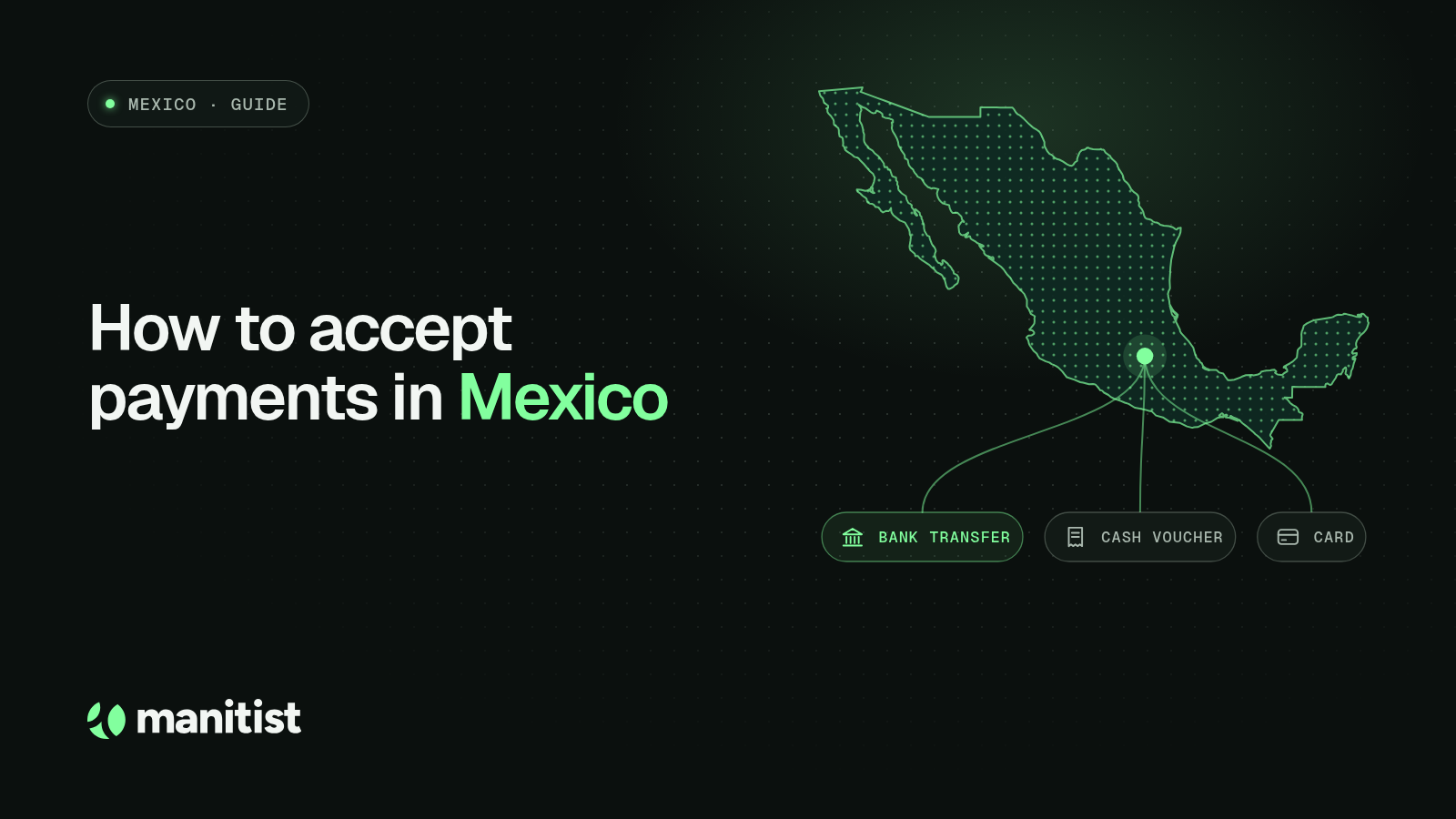
In Mexico, a card-only checkout leaves out customers who prefer other methods. Customers pay online by card, by bank transfer through SPEI, and in cash at convenience stores, and each method behaves differently once the customer clicks "pay". This guide explains how the main methods work, what changes in your order flow, and how to launch without surprises.
The three pillars of payments in Mexico
For most online businesses, a practical Mexican checkout rests on three methods:
- Cards, including credit-card installments known as meses sin intereses.
- SPEI bank transfers, the instant transfer system run by the central bank.
- Cash at OXXO, paid at the counter against a reference code.
Newer account-to-account options, CoDi and DiMo, run on top of SPEI. They are worth knowing, but SPEI itself is where most of the opportunity sits.
SPEI: instant bank transfers
SPEI (Sistema de Pagos Electrónicos Interbancarios) is owned and operated by Banco de México. It began operating on 13 August 2004 and works as a real-time settlement system on a 24/7 schedule: transfers can be sent, received and returned every day of the year, at any hour. Banxico describes the transfer as immediate and traceable, with an electronic payment receipt (CEP) for the person receiving it.
For a merchant, SPEI usually works like this:
- The customer picks bank transfer at checkout.
- Your payment layer shows a CLABE or payment reference tied to that order and an amount.
- The customer sends the transfer from their own banking app.
- Your system receives a confirmation and releases the order.
What is a CLABE?
The CLABE is the 18-digit standardized bank account number used for interbank transfers. According to the Mexican Association of Banks, the first three digits identify the bank, the next three the city or branch area, the next eleven the account number, and the last digit is a check digit. The check digit helps catch typing mistakes, but it does not prove that an account exists, which is why payout flows should validate beneficiary details.
Design notes for SPEI
- Use one unique reference per order. It makes reconciliation automatic instead of manual.
- Expect the customer to leave your page. The payment happens in a bank app, so confirm via webhook, not by waiting on the checkout page.
- Handle wrong amounts and late transfers. Decide in advance what happens if a customer sends a different amount or pays after the order expires.
- SPEI also works for payouts. Because the system runs 24/7, you can send withdrawals to Mexican bank accounts at any hour, including weekends.
CoDi and DiMo
Both services were built by Banxico on SPEI's infrastructure. CoDi started operating in 2019 and uses QR codes and NFC so a merchant can request a transfer. DiMo started in 2023 and lets a customer send a transfer by entering only the recipient's phone number, with the recipient's initials shown for verification. Banxico's 2025 infrastructure report records 4.4 million CoDi operations during 2025, which is a useful reminder to size effort by your customers' behavior rather than by novelty. For most merchants, they are worth monitoring, not building a checkout around.
OXXO: cash payments
Cash remains an option for customers who prefer not to pay by card online, and OXXO is a well-known place to pay. FEMSA reported 24,297 OXXO stores in Mexico at 31 December 2025, and an average of about 13 million tickets per day nationwide in 2025. Those ticket figures count all store transactions, not only online payments, but they show how embedded the chain is in daily life.
A cash voucher flow works differently from the other methods:
- The customer selects OXXO at checkout.
- Your payment layer generates a payment reference and an expiry date.
- The customer takes the reference to a store and pays in cash at the counter.
- The payment is confirmed to your system, and you can fulfill the order.
Design notes for cash vouchers
- Treat the order as pending until confirmation arrives. Don't ship or unlock a service on the voucher alone.
- Set a clear expiry and show it. An unpaid voucher is a normal outcome, not an error.
- Send reminders. An email or message before expiry recovers payments that would otherwise be lost.
- Make the instructions obvious. Show the reference, the amount and the steps on the confirmation page and in the email.
Cards and meses sin intereses
Cards remain the most familiar method, and installments are a standard feature of Mexican credit-card shopping. Meses sin intereses (interest-free months) is a credit-card promotion that splits the price into fixed monthly payments with no interest over an agreed term, such as 6, 12 or 18 months. Mexican consumer authorities note that the installment is not part of the minimum payment and that missed payments can add interest. Because customers know the feature, many expect to see it at checkout, so check whether your setup supports installments for the cards you target.
A practical launch checklist for Mexico
- Price in Mexican pesos and show the amount clearly, so customers don't have to think about conversion.
- Offer the checkout in Spanish.
- Show the three core methods (cards, SPEI, OXXO) before adding anything more.
- Handle asynchronous states. SPEI and cash orders are not paid instantly from your system's point of view, so build pending, paid, expired and failed states from day one.
- Rely on webhooks. A confirmation webhook is more reliable than polling and keeps the order flow fast.
- Plan refunds. Refunding a bank transfer or a cash payment usually means sending money back to the customer's account, so decide how you will collect or validate those details.
- Check tax, invoicing and licensing requirements for your business model with a local adviser. They depend on how you operate.
Common mistakes to avoid
- Treating a generated voucher as a sale. Revenue exists when payment is confirmed, not when the reference is created.
- Letting orders expire silently. Tell customers when a voucher or transfer window closes and offer a way to restart.
- Hiding what happens next. After the customer picks SPEI or OXXO, spell out the next step on screen and by email.
- Reconciling by hand. Without a unique reference per order, finance ends up matching transfers to orders manually.
One integration for Mexico and beyond
Integrating each Mexican rail yourself is possible, but it means separate flows for cards, transfers and cash, each with its own statuses and reporting. With payment orchestration, one integration covers them together and extends to other markets later.
Manitist lists SPEI, cards and OXXO for Mexico, plus withdrawals through SPEI, and states that SPEI withdrawals land in up to 10 minutes; confirm current timings during onboarding. You can integrate through a REST API or the Hosted Payment Page, and settle in USDT or local currency. See the full coverage, the details on deposits and withdrawals, and how risk checks work at onboarding and on every transaction.
If you are planning a wider launch, read what payment orchestration is and why it matters in Latin America, our country-by-country payment methods guide and the guide to accepting payments in Colombia.
Ready to map your markets? Book a demo and a payments specialist will come back within one business day.
Updated: 23 November 2026
Frequently asked questions
What payment methods do I need to accept payments in Mexico?
A practical starting set is cards, SPEI bank transfers and OXXO cash vouchers. Cards cover familiar online shopping, SPEI offers instant bank transfers around the clock, and OXXO reaches customers who prefer to pay in cash at a store. Add other methods once you see real customer demand.
What is SPEI and how does it work for online payments?
SPEI is the real-time transfer system owned and operated by Banco de México, available 24/7. For online payments, the customer receives a CLABE or reference for the order, sends a transfer from their banking app, and your system receives a confirmation. Using a unique reference per order simplifies reconciliation.
How do OXXO cash payments work for online stores?
The customer selects OXXO at checkout and receives a payment reference with an expiry date. They pay in cash at an OXXO counter, and the payment is confirmed to your system. Keep the order pending until confirmation arrives, show the expiry clearly and send a reminder before the voucher expires.
What are meses sin intereses?
Meses sin intereses are a credit-card promotion in Mexico that splits a purchase into fixed monthly payments without interest over a set term, such as 6, 12 or 18 months. The installment is paid in addition to the minimum payment, so customers who miss it can incur interest.
Can I send payouts to Mexican bank accounts?
Yes. Because SPEI runs 24/7, payouts to Mexican bank accounts can be sent at any hour, including weekends. Validate the beneficiary's CLABE before sending, since the check digit only catches typing errors. Manitist offers withdrawals through SPEI as part of its Mexico coverage.
Can customers pay with SPEI at an OXXO store?
SPEI and OXXO are two separate payment methods. SPEI is a bank transfer the customer makes from their own banking app, available 24/7. OXXO is a cash voucher: the customer receives a payment reference at checkout and pays in cash at an OXXO counter. Offer both at checkout and let the customer choose; each payment is confirmed to your system separately.
Talk to Manitist
Tell us which markets you need. A payments specialist will come back within one business day.
Book a demo